
Beard Transplantation
Free ConsultationHistorically growing beard and moustache among men were signs of power and maturity. Especially in some cultures, men were allowed to work, enjoy entertainment, join the military, and get married after growing facial hair. Although in the last century the western world adopted a clean-shaved face as a sign of hygiene and civilization, with the advance of social media the image of men with full beards has made growing facial hair popular again.
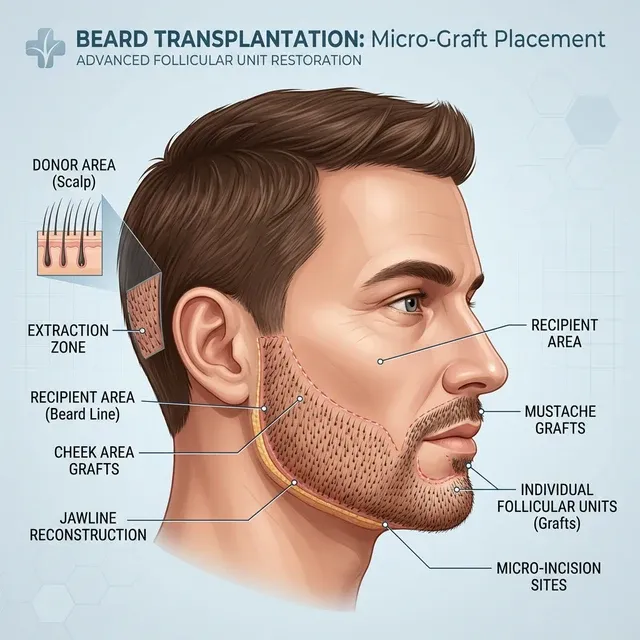
Beard transplant can be applied to men with no beard or very thin beard and is applied after the age of 18. The donor area for beard and moustache transplantation is the back of the head and neck area. The genetics of the hair from this area is immune to loss and through circulation and nutrition, it adapts to the implanted area. Just like in hair transplantation, local anesthesia is applied and then grafts are removed from the donor area with micro motors and transplanted to the face after channels are opened with Sapphire Blades.
The number of grafts to be transplanted depends on many factors such as the availability and quality of the donor area, as well as the size of the transplantation area. The direction of the channels plays an utmost role for a natural look and ease of aftercare. Since the nourishment of the face area is very rich, recovery is very fast.
The growth of beard and moustache starts right after the transplant procedure. Maximum care should be taken to protect the newly transplanted grafts. Within 10 days redness and scabs on the face disappear. Patients can expect shock loss within 1–2 months. Implants fully emerge from the 3rd month and full density is reached within 8–10 months. During this period, it is recommended that only scissors be used for cutting and trimming beard and moustache.
Beard Transplantation FAQ
Frequently asked questions about beard and moustache transplantation
Who is a good candidate for beard transplantation?
Beard transplantation is suitable for men aged 18 and over who have no beard, a very thin beard, patchy areas in their beard, or scarring from acne or injuries that affects beard growth. Candidates should have sufficient donor hair density at the back and sides of the scalp. A consultation with a specialist will confirm suitability based on hair quality and facial anatomy.
Where is the donor hair taken from for beard transplantation?
The donor area for beard and moustache transplantation is the back of the head and neck area — the same source used for scalp hair transplants. Hair from this area is genetically resistant to loss and adapts well to the face environment through circulation and nutrition, ensuring long-term results.
What technique is used for beard transplantation?
At OMG Clinic, beard transplantation is performed using the Sapphire FUE technique. After local anesthesia is applied, grafts are extracted one by one from the donor area using micromotor tools. Channels are then opened with sapphire blades at precise angles for a natural growth direction, and follicles are transplanted into the beard area.
Is beard transplantation painful?
The procedure is performed under local anesthesia, so you will not feel pain during the operation. Some mild discomfort may be experienced during the anesthesia injection itself. Post-procedure soreness in both the donor area (back of head) and the facial area is typically mild and manageable with prescribed medication.
How long does beard transplantation take?
A beard transplantation session typically takes 4 to 6 hours depending on the number of grafts required. The procedure involves anesthesia, graft extraction, channel opening with sapphire blades, and follicle placement. All stages are completed on the same day and you can return home the same day.
How many grafts are needed for a full beard?
The number of grafts needed varies depending on the desired density and the area to be covered. For a full beard including cheeks, chin and moustache, typically 3,000 to 4,500 grafts are required. For smaller areas like a goatee or filling patches, fewer grafts are needed. This is determined during consultation.
What is the recovery process after beard transplantation?
Within 10 days, redness and scabs on the face disappear. Shock loss (the transplanted hair shedding) is expected within 1–2 months — this is completely normal. New hair growth begins from the 3rd month, and full density is reached within 8–10 months. During this period, only scissors should be used for trimming — no razor blades.
When will I see the final results?
Beard transplant results develop gradually. New growth begins around month 3, visible improvement at months 4–6, and full natural density is achieved by 8–10 months after the procedure. The transplanted hair grows, behaves, and can be styled just like your natural beard.
Are beard transplant results permanent?
Yes, beard transplantation results are permanent. The donor hair used comes from the back of the scalp — an area genetically programmed to resist hair loss. Once transplanted to the facial area, these follicles maintain their genetic properties and continue to grow throughout life.
Can I choose the shape and density of my beard?
Yes, the beard shape, density, and hairline design are discussed and planned with your surgeon before the procedure. The direction and angle of each channel is carefully determined to create a natural-looking result that complements your facial structure. You can bring reference photos to help communicate your desired outcome.